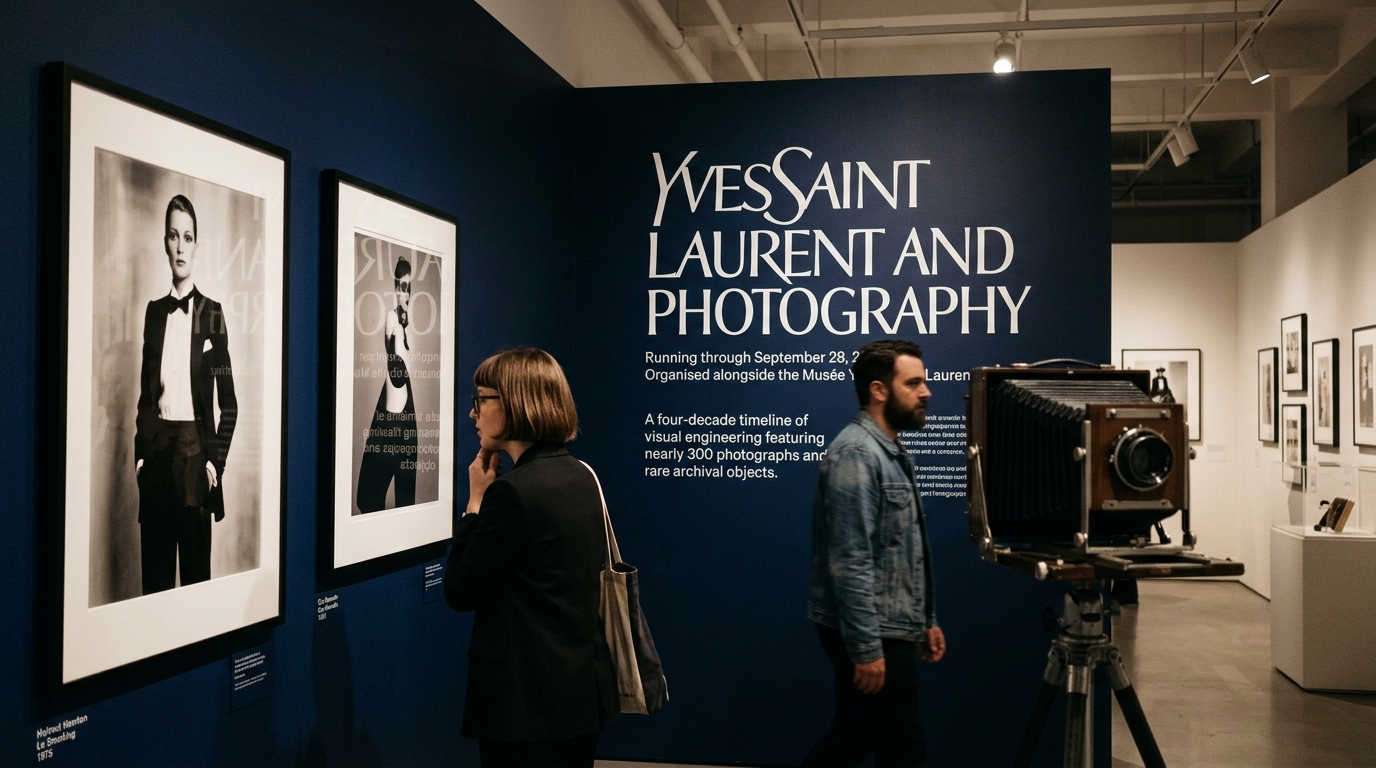
The intersection of fashion and the camera lens is a heavily trafficked crossroads. Yet few designers understood the sheer mechanical power of image-making quite like Yves Saint Laurent. The International Center of Photography in New York has mounted a new exhibition titled Yves Saint Laurent and Photography. Running through September 28, 2026, the retrospective examines a four-decade timeline of visual engineering.
Organized alongside the Musée Yves Saint Laurent Paris, the show features nearly 300 photographs and rare archival objects.
Saint Laurent did not merely tolerate the camera. He weaponized it to redefine modern dress codes. From his early days in 1957 to his twilight collections in the early 2000s, photography served as his ultimate cultural amplifier. The exhibition captures this symbiotic relationship perfectly. It illustrates how the medium transformed garments from mere woven textiles into enduring symbols of twentieth-century identity and power.
The visual record speaks for itself.
Visitors to the Ludlow Street gallery are greeted by a comprehensive timeline of portraiture and editorial work. The roster of featured photographers reads like a textbook of visual arts masters. Richard Avedon, Cecil Beaton, Helmut Newton, and Irving Penn all make significant appearances.
The exhibition cleverly divides itself into two distinct sections. The first focuses strictly on the creative output of these legendary lensmen. Irving Penn’s definitive 1957 portrait of the young designer sets the baseline. From there, the narrative winds through William Klein’s experimental 1962 shots and Bettina Rheims’ candid 1980s backstage runway imagery. Patrick Demarchelier provides a poignant 2004 portrait to close the loop.
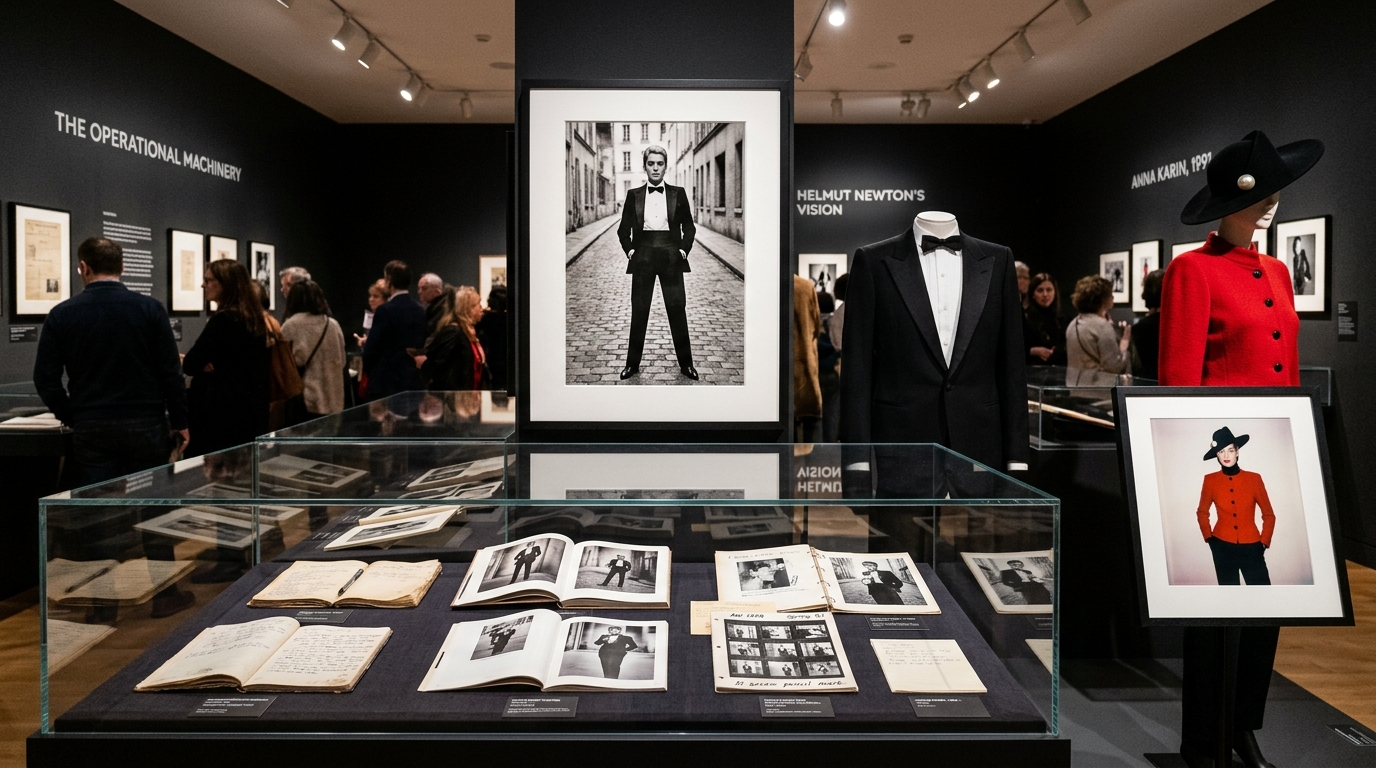
The second half of the exhibit delves into the operational machinery of the fashion house.
Over 200 museum archive loans fill the vitrines. Contact sheets, campaign catalogs, and personal photographs sit alongside weathered advertising notebooks. These ephemera highlight the meticulous planning required to construct an international luxury brand.
The garments themselves remain the focal point of the captured imagery. Helmut Newton’s stark, geometric framing of the 1966 Le Smoking tuxedo remains a masterclass in shifting gender paradigms. The sharp tailoring and bold silhouettes translated flawlessly into high-contrast black and white photography. It is a testament to the fact that Saint Laurent designed clothes with the final printed image already fixed in his mind.
Even the casual polaroids radiate an undeniable modernity.
A 1991 staff polaroid featuring model Anna Karin in a red knit haute couture jacket proves this point. The asymmetrical wool hat and oversized pearl hat pin look entirely contemporary. The styling bridges the gap between historical archive and modern mood board with effortless precision.

Andy Warhol also factors into the curation. His inclusion highlights the seamless crossover between fine art and commercial fashion during the late twentieth century. Saint Laurent frequently borrowed from artists to elevate his seasonal collections.
The 1965 Piet Mondrian tribute dresses and the 1966 Homage to Pop Art cocktail dresses are prime examples. When captured by the leading editorial photographers of the era, these garments ceased to be mere apparel. They became highly coveted cultural artifacts. The resulting magazine spreads essentially functioned as portable art galleries for an aspirational global audience.
This strategic use of media cemented the brand's position in the global luxury market.
Similarly striking is the documentation of Bess Stonehouse in a pink organza evening dress from the Spring 1990 haute couture collection. The whimsical volume of the fabric is grounded by surreal layered jewelry. Photography allowed these fleeting moments of runway theater to be frozen and studied by the masses. The lens democratized the exclusive world of Parisian haute couture.
Fashion today relies heavily on instant digital consumption.
The foundation of this visual economy was laid by designers like Saint Laurent. He utilized glossy magazines and billboard campaigns to build an aura of exclusivity that continues to drive billion-dollar sales today.

The International Center of Photography has curated a necessary examination of fashion history. The show may occasionally feel like a straightforward compilation of archival hits. Yet it undeniably proves that Yves Saint Laurent understood the assignment long before his peers. He knew that the clothes would eventually fray. He also knew a perfectly lit photograph could secure his legacy forever.
The exhibition remains open to the public through the end of the summer season.
Frequently Asked Questions
What are the dates for the Yves Saint Laurent and Photography exhibition?
The exhibition runs from June 11 through September 28, 2026. It is hosted at the International Center of Photography in New York City.
Where is the International Center of Photography located?
The International Center of Photography is situated at 84 Ludlow Street in Manhattan. It houses both the museum gallery and an extensive photography library.
Which photographers are featured in the YSL exhibition?
The showcase includes works from major twentieth-century talents. Visitors will find iconic photographs by Richard Avedon, Helmut Newton, Irving Penn, Annie Leibovitz, and Andy Warhol.
Did Yves Saint Laurent design the 1966 Le Smoking tuxedo?
Yes. Yves Saint Laurent introduced the groundbreaking Le Smoking tuxedo for women in 1966. The garment is heavily featured in the exhibition through archival photography.
How many objects are on display at the ICP exhibition?
There are nearly 300 photographs and archival items on display. This includes over 200 museum archive loans such as campaign catalogs, personal photographs, and contact sheets.
Who collaborated with the ICP to organize this event?
The exhibition was organized in collaboration with the Musée Yves Saint Laurent Paris. The Fondation Pierre Bergé–Yves Saint Laurent also served as a primary production partner.