
Medical science has historically treated human sexuality with a mix of puritanical avoidance and clinical detachment. The recent news that researchers found the male G-spot disrupts this quiet consensus. A team led by Alfonso Cepeda-Emiliani at the University of Santiago de Compostela has mapped the penile nervous system. The findings rewrite the standard anatomical texts.
For decades, textbook diagrams pointed to the glans as the ultimate epicenter of physical sensation. They were entirely wrong.
The actual focal point is an overlooked patch of tissue located on the ventral underside of the penis. This is where the shaft meets the head. Researchers examined fourteen adult cadaveric specimens from donors aged forty-five to ninety-six. They sliced the tissue into sections just a few micrometers thick. Special dyes revealed a staggering concentration of sensory architecture.
This highly sensitive region is called the frenular delta.
Ken McGrath at the Auckland University of Technology originally coined the term in 2001. The name references the triangular shape nestled between the wings of the glans. The medical establishment largely ignored it.
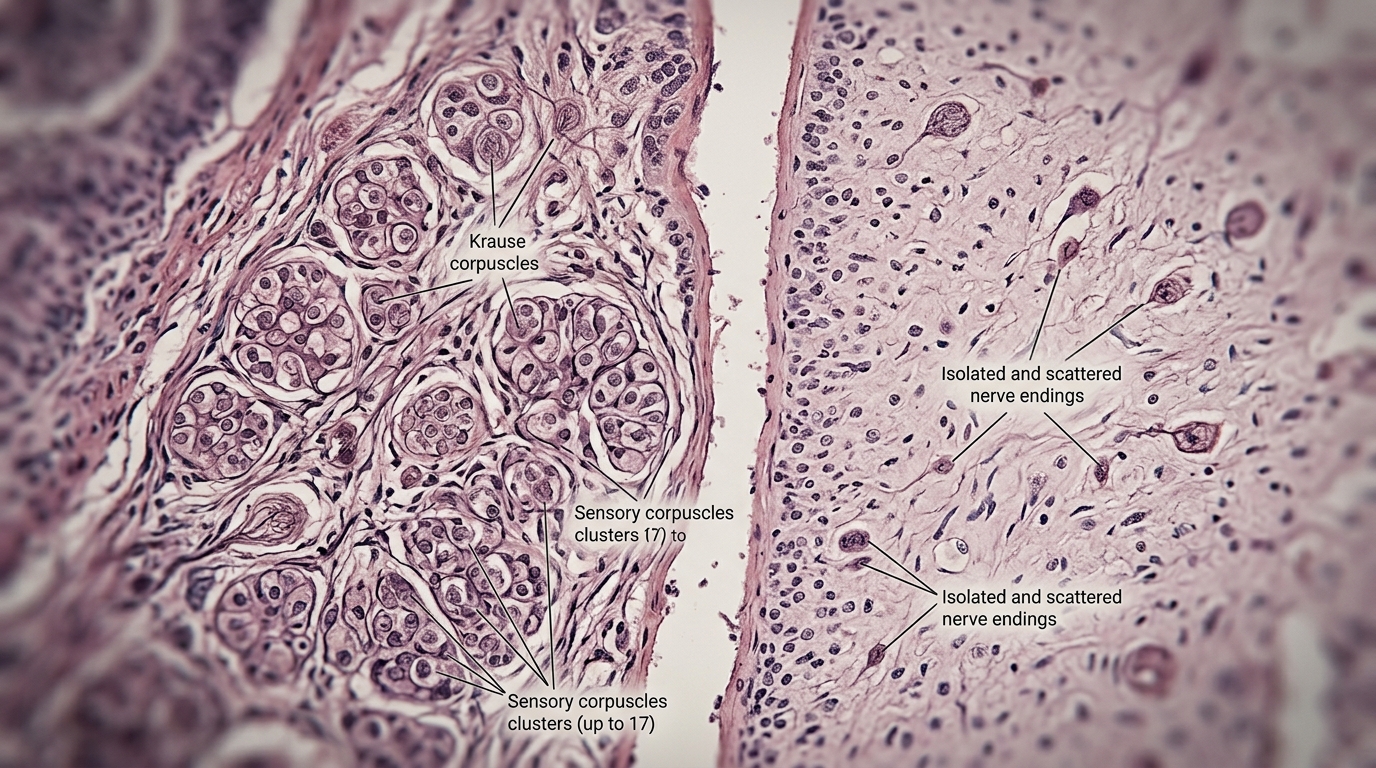
Under the microscope, the frenular delta reveals densely packed clusters of sensory corpuscles. These specialized touch receptors appear in groups of up to seventeen. The glans, by contrast, only features isolated and scattered nerve endings. This dense cluster includes Krause corpuscles. These specific receptors detect the minute physical vibrations of skin rubbing on skin.
Researchers also traced the prenatal development of this exact sensory network by studying thirty different fetal specimens.
From eight to sixteen weeks of gestation, nerves spread rapidly through the developing tissue. Specialized touch receptors only begin to appear between seventeen and twenty-four weeks. The early excess wiring eventually recedes. A highly specific pattern persists into adulthood. This leaves the frenular region exceptionally rich in nerve tissue compared to the surrounding anatomy.
The medical implications of this mapping are significant.
Surgical training has largely failed to acknowledge this zone. Kesley Pedler at Port Macquarie Base Hospital noted that the most respected urological textbooks entirely omit the frenular delta from their current pages.

Routine procedures like circumcision routinely intersect with this highly innervated tissue. Deep incisions along the ventral side or the complete removal of the frenulum directly compromise this sensory center. The study authors argue that surgeons must understand this nerve architecture before operating. Standard consent forms rarely address the potential loss of sensation.
Some experimental procedures for premature ejaculation pose even greater risks to this delicate and complex neural network.
Penile neurotomy involves cutting or cauterizing nerves in this exact area. The researchers warn that this practice lacks robust scientific evidence or ethical regulation. Reports of permanent sensation loss and erectile dysfunction frequently follow such interventions. The profound psychological fallout from compromising a structure built for sexual reward cannot be overstated.
Anatomy dictates function in ways we are just realizing.
The female anatomy has suffered from similar medical blind spots. The Spanish research team is already conducting parallel studies on cadaver vaginas and clitorises. They aim to map the true physical boundaries of the human body.

Human pleasure is a complex biological mechanism rooted in precise cellular structures. The identification of the frenular delta validates subjective human experience through rigorous microscopic analysis. Science is finally catching up to the physical realities of the human body. Understanding our own sensory map is the first step toward better medical practices and boundaries.
True physiological knowledge replaces outdated clinical myths with undeniable structural facts.
Frequently Asked Questions
Where is the male G-spot actually located?
It is located on the ventral underside of the penis, where the shaft meets the glans. This specific triangular area is scientifically referred to as the frenular delta.
What did researchers discover about the frenular delta?
Researchers found that the frenular delta contains the highest concentration of specialized touch receptors and nerve endings. These sensory corpuscles appear in dense clusters of up to seventeen rather than being isolated.
Does circumcision affect the male G-spot?
Circumcision can affect this region if surgeons make deep incisions along the ventral side or remove the frenulum entirely. This may alter the complex nerve networks and potentially reduce physical sensation.
What are Krause corpuscles?
Krause corpuscles are specialized touch receptors found in high density within the frenular delta. They are responsible for detecting the minute physical vibrations that occur when skin rubs against skin.
Why was the glans previously considered the most sensitive area?
Anatomical textbooks historically mapped the glans as the primary sensory center due to its prominent location and general nerve presence. The latest microscopic tissue analysis proves the frenular delta is far more densely packed with receptors.