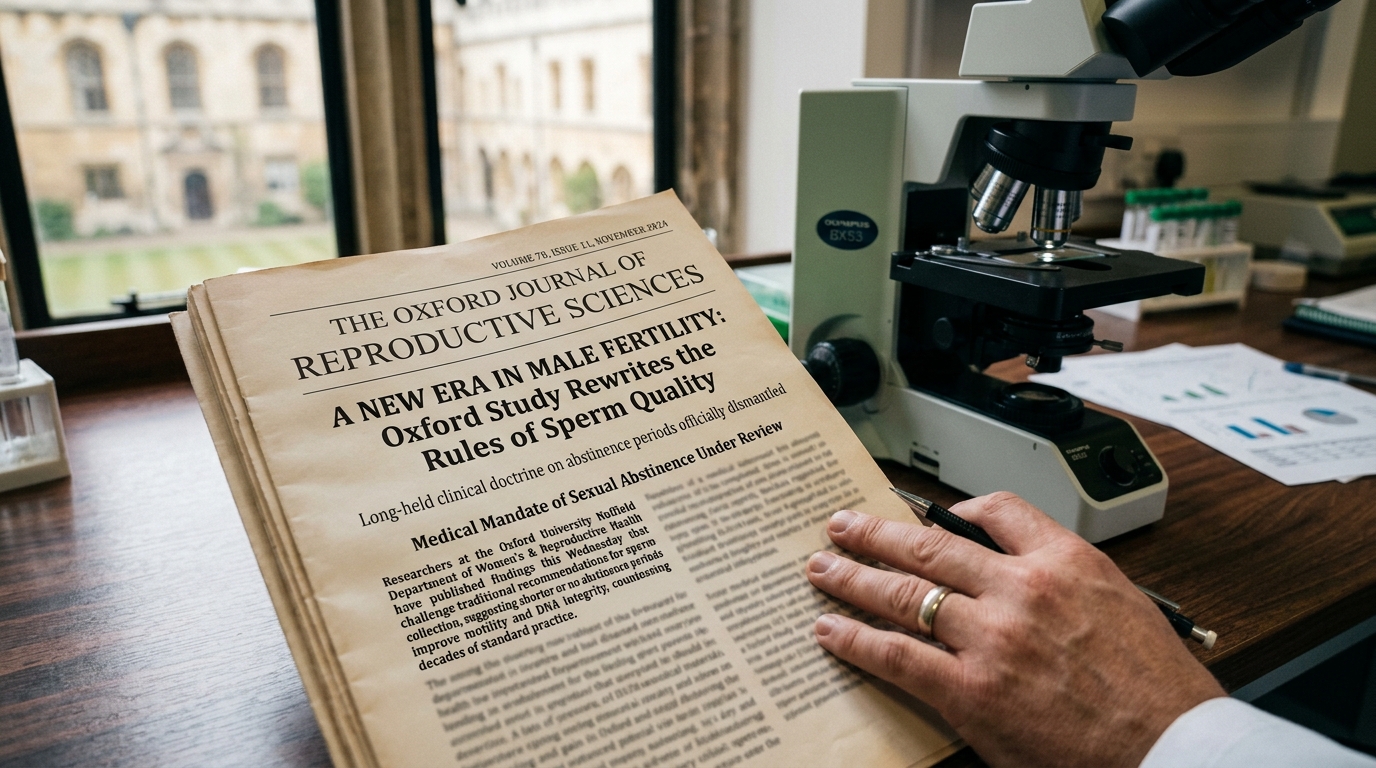
The Oxford University sperm quality study has arrived to rewrite the rules of reproductive science. Published this Wednesday, the research dismantles a long-held clinical doctrine. The medical mandate of sexual abstinence is officially under review.
The conversation surrounding fertility has historically centered on the female biological clock.
Women are born with a finite reserve of eggs that age synchronously with their bodies. Men generate reproductive cells continuously from puberty onward. The medical establishment previously assumed this constant production offered a perpetual biological advantage. This new meta-analysis reveals a critical flaw in that logic. Stored cells deteriorate at an alarming rate regardless of the man's age.
Biology operates with ruthless efficiency when resources are left stagnant.

Researchers analyzed data from 115 human studies encompassing nearly 55,000 men. The findings highlight a definitive link between prolonged abstinence and significant cellular degradation. Motility drops. Viability plummets. DNA damage escalates.
The culprit is an unavoidable combination of oxidative stress and severe energy depletion.
Dr. Rebecca Dean of the Department of Biology attributes this to post-meiotic senescence. These highly active cells simply run out of fuel. They exhaust their limited energy reserves while waiting. Oxidative stress then acts as a biological rust that physically damages the cellular structure during extended periods of storage.
A paradigm shift in fertility treatment protocols is now inevitable.
Current World Health Organization guidelines advise a waiting period of two to seven days before providing a sample for clinical analysis or in vitro fertilization. The Oxford researchers suggest this protocol prioritizes sheer volume over actual quality. Dr. Krish Sanghvi notes that while abstinence increases the total count, it simultaneously guarantees a higher percentage of damaged cells.
Precision is rapidly replacing sheer volume in reproductive medicine.

Clinical trials corroborate this fundamental shift in strategy. Pregnancy rates in IVF treatments hit forty-six percent when the abstinence period was kept under forty-eight hours. The success rate dropped significantly with longer waits.
The biological phenomenon extends far beyond human reproduction.
The team examined fifty-six studies across thirty different animal species. The evolutionary evidence is incredibly consistent. From reptiles to birds, stored reproductive material reliably declines in quality. Yet females of certain species have evolved specialized organs to secrete antioxidants and preserve these cells longer.
Dr. Irem Sepil suggests these female adaptations could inspire future biomimicking tech.
Frequent ejaculation serves a clear adaptive purpose. It effectively flushes out damaged cells and makes room for fresh production. Professor Allan Pacey agrees that assisted reproductive technology requires the healthiest samples available.
Cellular stagnation inevitably breeds rapid biological deterioration.
Volume is no longer the ultimate metric for success. Modern techniques like intracytoplasmic sperm injection require only a minimal number of viable cells. The old methodology of saving up material is biologically counterproductive. Environmental toxins and genetics remain entirely outside our control. Storage duration is easily manageable.
Science has finally debunked the virtue of reproductive patience.
For couples attempting to conceive naturally, this data offers actionable clarity. The sweet spot exists somewhere between complete depletion and extended hoarding. Medical professionals must now guide patients toward a balanced rhythm. The goal is maintaining a fresh supply without exhausting the baseline count.
Frequently Asked Questions
Does abstaining from ejaculation improve sperm quality?
No. While abstinence increases the total sperm count, it significantly reduces the overall quality. Stored sperm suffers from DNA damage, decreased motility, and lower viability due to oxidative stress and energy depletion.
How many days should a man abstain before providing a sperm sample?
The World Health Organization currently recommends two to seven days. However, Oxford University researchers have found that waiting less than 48 hours actually produces healthier, higher-quality sperm for procedures like IVF.
What is oxidative stress in sperm?
Oxidative stress acts like a biological rust on the cells. It accumulates when sperm is stored in the body for too long, physically damaging the cellular structure and reducing the chances of successful fertilization.
Does age affect male fertility?
Yes. Male fertility naturally declines with age. The Oxford study clarifies that the age of the stored sperm itself also plays a massive role, meaning even young men produce poor-quality samples if they abstain for too long.
Can female bodies store sperm better than males?
Yes. The study found that females across various animal species are generally better at preserving sperm quality. Certain female reproductive systems have evolved specialized organs that secrete antioxidants to nourish and protect the cells.
Why is sperm quality more important than quantity for IVF?
Modern assisted reproductive technologies require very few viable cells to achieve fertilization. Clinics prioritize the freshest and most mobile sperm over sheer volume to maximize the chances of a successful pregnancy.
How does frequent ejaculation benefit male fertility?
Frequent ejaculation acts as a natural flushing mechanism. It clears out older, damaged, and energy-depleted cells from the reproductive tract, ensuring that freshly produced and highly viable sperm are available for fertilization.