The relationship between our environment and our biology is undergoing a quiet, structural shift. A recent research review suggests that microplastics and nanoplastics may be fueling the rise of Parkinson's disease. This investigation, spearheaded by scientists from Gannan Medical University and Guangzhou Medical University, examines how these ubiquitous synthetic fragments infiltrate the human central nervous system. It is no longer just a matter of ecology. It is a matter of neurological integrity.
The prevalence of Parkinson's disease has doubled in the last twenty-five years. This surge suggests that genetic factors alone cannot account for the diagnostic trend.
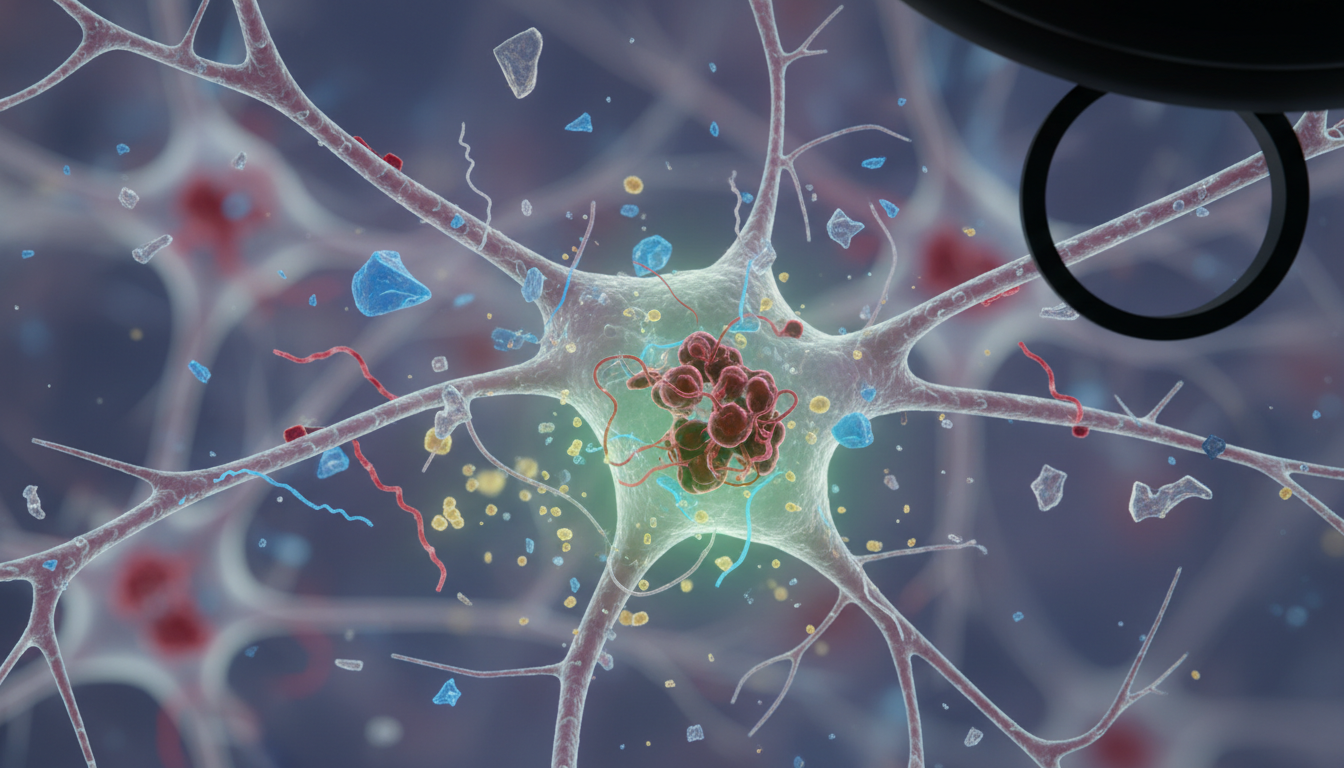
Researchers analyzed over one hundred studies, including animal models and laboratory experiments, to map the path of plastic from the environment to the brain. These particles enter the body through ingestion, inhalation, and even skin contact. Once inside, they demonstrate a chilling ability to cross the blood-brain barrier or enter through the nasal cavity. The review specifically highlights how these fragments might encourage the formation of toxic alpha-synuclein protein clumps. These clumps are the hallmark of Parkinson's pathology.
The materiality of our daily lives is essentially shedding into our bloodstream.
Microplastics are defined as fragments smaller than five millimeters. Nanoplastics are even more elusive, measuring less than a micrometer. They originate from the disintegration of plastic waste and the laundering of synthetic clothing. These fibers are so fine they bypass standard filtration. Once they reach the brain, they may trigger neuroinflammation or disrupt the critical communication channel between the gut and the brain. There is also evidence they carry damaging metals that induce ferroptosis.
We are witnessing the industrialization of human pathology through a material we once celebrated for its permanence.
The verdict is a call for scientific rigor rather than panic. While the link is compelling, current research is largely based on animal testing and high-dosage laboratory scenarios. We need human-centric data to confirm these chronic effects. However, the sheer ubiquity of plastic makes this an urgent frontier for public health.
The "credit card a week" ingestion myth has been largely debunked by more recent scrutiny. Some estimates suggest the actual mass of plastic ingested is closer to a grain of salt. This distinction is vital for maintaining a grounded perspective. We must focus on the chemical leaching and the cellular interaction rather than the volume alone. The way these particles accumulate over a lifetime is the real concern.
Our bodies were never designed to process the synthetic byproducts of the twentieth century.
The researchers emphasize that we must look at the specific properties of these polymers. Size, shape, and surface charge all dictate how a particle behaves once it enters a cell. A jagged fragment from a discarded bottle may interact differently than a smooth fiber from a polyester blend. This is the craft of toxicology. It requires a meticulous eye for detail and a refusal to settle for broad generalizations.

There is an intellectual honesty in admitting what we do not yet know. The field of microplastic research is still in its infancy. Many early studies have faced criticism for potential contamination or false positives during tissue analysis. Vaporized fat can sometimes mimic the signature of plastic in laboratory tests. We must demand a higher standard of evidence before we rewrite the history of neurodegeneration.
Waste management is no longer an external logistical problem. It is a preventative healthcare strategy.
The shift toward biodegradable alternatives and improved waste infrastructure is essential. We are currently living in a landscape of our own making, where the convenience of the past is the toxicity of the present. As the global population ages, the burden of Parkinson's will only grow. Addressing the invisible hazards of our environment is the only way to safeguard the future of the mind.
Frequently Asked Questions
What did the Gannan and Guangzhou Medical University study discover?
The research review linked microplastics and nanoplastics to brain processes that drive Parkinson's disease. It suggested that these particles could promote the formation of toxic protein clumps and cause neuroinflammation.
How do microplastics enter the human brain?
Tiny plastic fragments can enter the body through food, water, and air. They reach the brain by crossing the blood-brain barrier or by traveling through the nerve cells that line the nasal cavity.
Is it true that people eat a credit card's worth of plastic every week?
No. Recent scientific scrutiny has debunked this claim as an exaggeration based on flawed mathematics. Actual ingestion levels are likely much lower, though the long-term effects of any amount remain a concern.
What is the difference between microplastics and nanoplastics?
Microplastics are fragments smaller than five millimeters. Nanoplastics are significantly smaller, measuring less than one micrometer, which allows them to penetrate cellular membranes more easily.
Can synthetic clothing contribute to microplastic pollution?
Yes. Washing synthetic fabrics like polyester and nylon releases millions of tiny plastic fibers into the water system. These fibers are a major source of environmental and biological contamination.
What biological processes in the brain are affected by plastics?
Plastics may encourage the clumping of alpha-synuclein proteins and disrupt gut-brain communication. They can also carry heavy metals into the brain, potentially leading to a type of cell death known as ferroptosis.
Are the findings of this study confirmed in humans?
Not yet. Most of the evidence currently comes from animal models, computational simulations, and laboratory cell experiments. Scientists are calling for more extensive human data to understand the chronic risks.