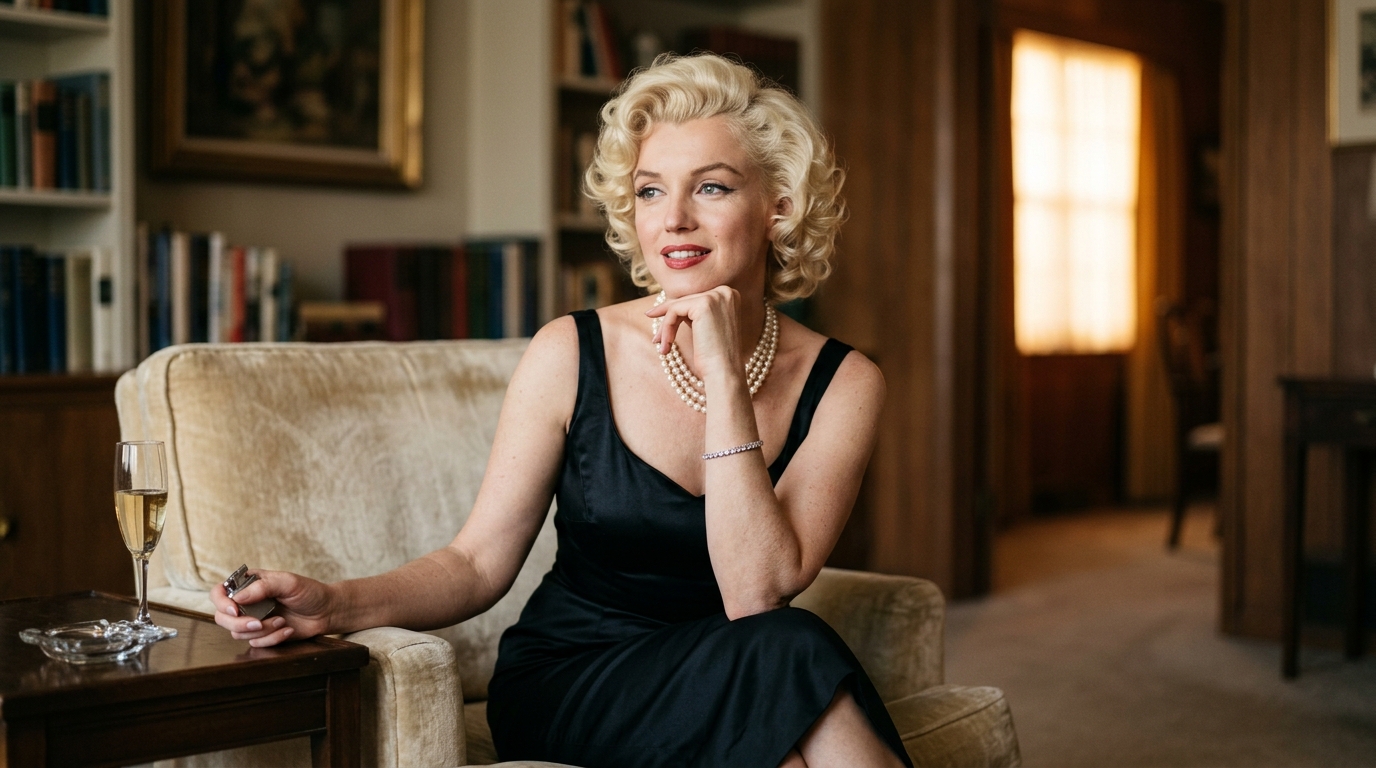
Marilyn Monroe's personal library is the unseen foundation of her cultural legacy. We are currently exploring the Marilyn Monroe Hollywood Icon exhibition in Los Angeles. The year 2026 marks her centenary celebration. We all know the pink dress from Gentlemen Prefer Blondes. We know the platinum curls. Yet the most striking artifacts are completely devoid of studio sequins.
Her true refuge was not the silver screen. It was her personal library of texts. At the time of her death she owned over four hundred books.
The contrast between the studio manufactured bombshell and the private intellectual is profound. Monroe suffered from crippling imposter syndrome. She sought solace in the heavy volumes of Marcel Proust and Albert Camus. Her reading habits were rarely treated with respect. Photographers caught her reading Ulysses by James Joyce. The press immediately dismissed it as a cheap stunt.
The photographer later confirmed she was genuinely reading it.
Her library traveled with her through forty nine different residences. It was a grounding force in a life marked by deep instability. The collection lacked contemporary bestsellers. She focused fiercely on self improvement.
We see this intellectual hunger documented thoroughly in the exhibition. Annotated scripts and handwritten letters reveal a sharp mind. She wrote a letter to director John Huston declining a role in a Sigmund Freud biopic. She noted that the Freud family did not approve of the project. Her books were heavily marked. They were covered in her own marginalia and private thoughts.
Monroe possessed strong opinions about the literary giants. She did not blindly worship the celebrated male authors of her time.
Her critique of Ernest Hemingway was particularly sharp. She observed that his notoriously tough characters were actually quite sick. She recognized that they always needed to kill something just to prove their worth. This is a highly astute reading of midcentury masculinity. It came from a woman who was constantly reduced to a punchline by the men in her own social circles.
Arthur Miller's friends treated her like a dull sex object.
Miller himself insulted her intelligence in a private diary. Monroe discovered the diary and read his cruel words. This betrayal directly led to their divorce. It reinforced her deep anxieties about intellectual worth.
She took literature seriously enough to formally study it. In 1951 she enrolled in two literature classes at UCLA. Her career was just taking off. She still prioritized the ten week courses. Her ultimate ambitions were surprisingly classical. She dreamed of playing Ophelia and Lady Macbeth. She even imagined launching a Marilyn Monroe Shakespeare Festival later in her career.
The centenary celebrations extend far beyond the museum. Palm Springs recently hosted a massive lookalike event at Downtown Park.
Hundreds gathered to break a world record in her honor. Organizers required participants to wear red lipstick and inspired attire. Authentic Brands Group continues to license her image globally today. Over half of her massive social media following is under the age of thirty four. They connect with her resilience. They appreciate her self starter story against massive odds.
Her financial independence is also a documented reality now.
Scott Fortner owns the Marilyn Monroe Collection. He points to bank records proving she bought her Brentwood house entirely on her own. She did not need to borrow the deposit money from her former husband Joe DiMaggio.

The afterlife of her personal library is somewhat tragic. After her overdose in 1962 the stacks of books had no clear destination. They were packed up and shipped from Los Angeles to a Manhattan storage unit. They sat in the dark until Lee Strasberg died in 1982. His third wife Anna Strasberg eventually inherited the estate. The entire collection was sent off to the highest bidder.
Christie's auction house sold the library in 1999. Volumes of Walt Whitman and Fyodor Dostoevsky were scattered into private hands.
We are left with the titles as a map of her mind. The list spans from Ralph Ellison to F. Scott Fitzgerald. It includes heavy philosophy and classic poetry. She used poetry to process her overwhelming insomnia and anxiety. The Hollywood icon we celebrate at one hundred was a creation. The woman who sought comfort in the pages of The Brothers Karamazov was the beautiful reality.
The public narrative is finally beginning to shift in 2026.
She was not just a tragic figure in a pink satin gown. She was a dedicated student of the human condition. Her library proves that she possessed a quiet brilliance. That intellect outlives the studio machine that built her.
Frequently Asked Questions
How many books were in Marilyn Monroe's personal library?
At the time of her death, Marilyn Monroe owned over 400 books. The collection included classic literature, heavy philosophy, and historical biographies.
Did Marilyn Monroe take college classes?
Yes. She enrolled in two ten-week literature classes at UCLA in 1951. She dedicated time to these courses just as her Hollywood career was taking off.
What did Marilyn Monroe think of Ernest Hemingway?
She was highly critical of his work and perspective. She stated that his famously tough characters were actually sick and obsessed with proving themselves through violence.
What happened to Marilyn Monroe's books after she died?
The books were initially inherited by her acting coach, Lee Strasberg. His widow, Anna Strasberg, later sold the entire library through Christie's auction house in 1999.
When does the Marilyn Monroe Hollywood Icon exhibition run?
The exhibition at the Academy Museum of Motion Pictures opens on May 31, 2026. It will remain open to the public until February 28, 2027.